
VAT registration does not always continue for the entire life of a business. A company may close, stop making taxable supplies or experience a major fall in taxable turnover. In these situations, the business may need, or may be permitted, to cancel its VAT registration with the Federal Tax Authority.
However, VAT deregistration is not completed simply by cancelling a trade licence or stopping business activity. A separate application must be submitted through EmaraTax, supported by financial information and documents explaining why the business qualifies.
Understanding how to cancel VAT registration in UAE is important because applying too early, selecting the wrong reason or missing a mandatory deadline can lead to delays, rejected applications and administrative penalties.
This guide explains when VAT deregistration is mandatory, when it can be voluntary, how the online process works and what businesses must complete before the Federal Tax Authority approves the cancellation.
What Does VAT Deregistration Mean?
VAT deregistration is the official process of cancelling a business’s VAT registration with the Federal Tax Authority. Once the application is approved, the business stops being treated as a VAT registrant from the effective deregistration date.
This normally means the business can no longer charge VAT on taxable supplies or recover input VAT on purchases made after that date. Its Tax Registration Number, commonly called a TRN, will no longer be active for VAT purposes.
Deregistration does not remove liabilities that arose while the business was registered. The FTA may still claim unpaid tax, penalties or other amounts relating to earlier tax periods.
Mandatory and Voluntary VAT Deregistration at a Glance
| Type | General condition | Application deadline |
| Mandatory deregistration | The business stops making taxable supplies and does not expect to make them during the next 12 months | Within 20 business days of the deregistration obligation arising |
| Mandatory deregistration | Taxable supplies during 12 consecutive months fall below AED 187,500 and expected supplies or taxable expenses will not exceed that amount during the next 30 days | Within 20 business days |
| Voluntary deregistration | Taxable supplies during the previous 12 months are below AED 375,000 but the business does not meet a mandatory deregistration condition | No mandatory 20-day deadline generally applies |
| Restriction for voluntary registrants | A person originally registered voluntarily cannot apply within the first 12 months after VAT registration | Application becomes possible after the restriction ends, subject to eligibility |
The correct category depends on the business’s taxable supplies, expected activity, registration history and reason for applying.
When Is VAT Deregistration Mandatory?
VAT deregistration becomes mandatory when a registered person no longer meets the legal conditions for remaining registered.
The Business Has Stopped Making Taxable Supplies
A registrant must apply when it has stopped making taxable supplies. Under the VAT Executive Regulations, the FTA may approve the application where the registrant has ceased making relevant supplies and does not expect to make them during the next 12 months.
This may apply when a company has permanently closed, entered liquidation, sold its business or discontinued all activities that create taxable supplies.
A temporary pause does not always mean the business should deregister. Before applying, management should consider whether taxable activity is likely to restart during the following 12 months.
Taxable Supplies Have Fallen Below AED 187,500
Mandatory deregistration can also arise when taxable supplies made over 12 consecutive months are below the voluntary registration threshold of AED 187,500.
The business must also not expect its taxable supplies or taxable expenses to exceed AED 187,500 during the next 30 days. When both conditions apply, remaining registered is generally no longer optional.
The Business Has Been Dissolved or Liquidated
Closing a company usually ends its taxable activities, but VAT deregistration is still a separate compliance process.
Cancelling a mainland or free-zone trade licence does not automatically remove the VAT registration. The company should review its final transactions, submit the deregistration application, complete its final VAT return and settle outstanding amounts.
The FTA may request documents such as a cancelled trade licence, liquidation letter, board resolution and recent financial statements.
When Can Deregistration Be Voluntary?
A registrant may apply for voluntary VAT deregistration when its taxable supplies during the previous 12 months are below the mandatory registration threshold of AED 375,000.
In practical terms, this normally applies when the business continues making taxable supplies, but its annual taxable turnover is between AED 187,500 and AED 375,000.
The business is not forced to deregister because its turnover remains above the voluntary threshold. It may choose whether remaining VAT-registered continues to make commercial and administrative sense.
For example, a business with AED 280,000 in taxable supplies may be eligible to apply voluntarily. It could also decide to remain registered, continue issuing tax invoices and recover eligible input VAT.
A person who originally registered voluntarily under Article 17 of the VAT Law cannot apply for deregistration within 12 months from the VAT registration date.
Mandatory and Voluntary Deregistration Should Not Be Confused
The two turnover thresholds perform different functions.
If taxable supplies are below AED 187,500 and the forward-looking condition is also met, deregistration may be mandatory.
If taxable supplies remain above AED 187,500 but are below AED 375,000, deregistration may be voluntary.
Falling below AED 375,000 does not by itself make deregistration mandatory. Likewise, a business below AED 187,500 should not treat the decision as optional when all mandatory conditions have been met.
What Should You Check Before Applying?
Before starting the application, the business should confirm that the figures in its VAT returns agree with its accounting records.
The taxable turnover calculation should be supported by invoices, ledgers, financial statements and other records. Management should also consider expected supplies and taxable expenses during the relevant forward-looking period.
Any missing VAT returns, incorrect declarations or unpaid amounts should be identified early. VAT deregistration does not remove earlier compliance problems, and the FTA will not fully complete the process until the required returns and liabilities have been addressed.
Where an error is discovered in an earlier return, the business may need to assess whether a correction or voluntary disclosure is required before deregistration. Capital Plus provides assistance with VAT return reviews and voluntary disclosure submissions where past reporting needs to be corrected.
How to Cancel VAT Registration in UAE Through EmaraTax
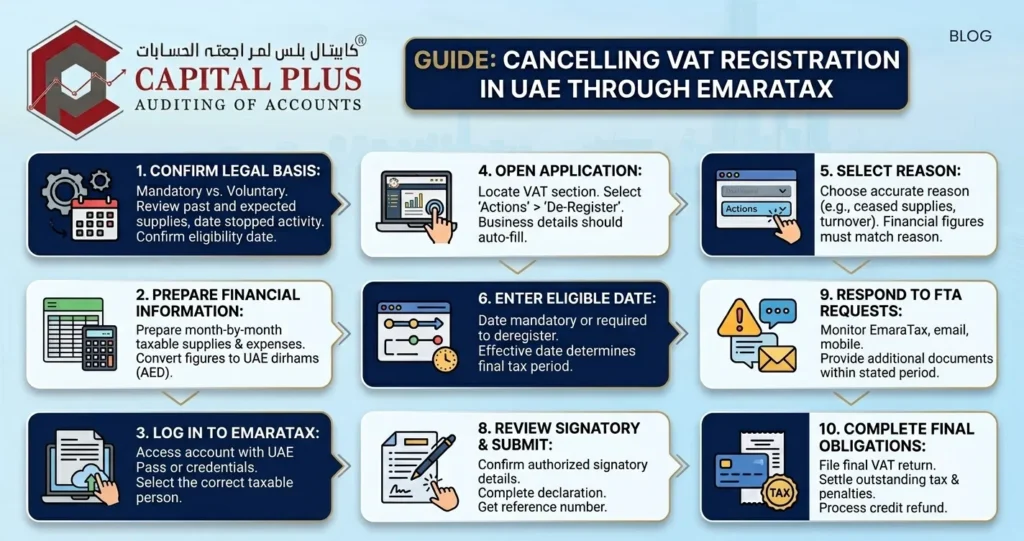
The VAT deregistration application is submitted online through the EmaraTax platform.
Step 1: Confirm the Legal Basis for Deregistration
First, determine whether the application is mandatory or voluntary.
Review taxable supplies for the previous 12 months, expected supplies and expenses, the date business activity stopped and the original basis of VAT registration.
The date on which the business first became eligible or required to deregister is important. It may affect the application deadline and effective deregistration date.
Step 2: Prepare the Financial Information
Prepare a month-by-month record of taxable supplies and taxable expenses for the period requested in the application.
The FTA allows the information to be entered directly into EmaraTax or uploaded using its spreadsheet template. Figures should be reported in UAE dirhams.
Step 3: Log In to EmaraTax
Access the EmaraTax account using the registered login details or UAE Pass.
Select the relevant taxable person from the account list and click View to open its dashboard.
Step 4: Open the VAT Deregistration Application
Locate the VAT section on the taxable person dashboard.
Select Actions and then choose De-Register. The business’s existing VAT registration details should appear automatically in the application.
Step 5: Select the Reason for Deregistration
Choose the basis that accurately describes the business’s position.
The available information and supporting-document fields may change according to the selected reason. Common reasons include cessation of taxable supplies, turnover below the voluntary threshold, turnover below the mandatory threshold, licence cancellation, licence sale or another change affecting registration eligibility.
Do not select a reason simply because it appears easier to support. The financial figures and uploaded records must match the legal basis selected.
Step 6: Enter the Eligible Date
Enter the date from which the business became eligible or required to deregister.
EmaraTax may calculate an effective date based on the information entered. The FTA may approve that date or determine another effective date under the applicable rules.
The effective date is important because it establishes when the final tax period ends and when the business must stop acting as a VAT registrant.
Step 7: Upload the Supporting Documents
Upload the documents requested for the selected deregistration reason.
The information in the application should be consistent with financial statements, trade-licence records, VAT returns and turnover schedules. Incomplete or contradictory documents may lead to further questions or resubmission.
Step 8: Review the Authorised Signatory Information
Confirm that the authorised signatory details are current and correct.
Review the entire application, complete the declaration and submit it through EmaraTax. After submission, the system generates a reference number that should be retained for follow-up with the FTA.
Step 9: Respond to FTA Requests
The FTA may approve, reject or request further documents.
Monitor the EmaraTax dashboard, registered email address and mobile number for updates. Where additional information is requested, respond within the period stated by the Authority.
Step 10: Complete the Final VAT Obligations
After pre-approval, the business may be required to submit a final VAT return, pay outstanding VAT and settle administrative penalties.
The deregistration will not be completed until all required VAT returns have been filed and relevant amounts have been settled. Where the account has a credit balance, a refund request may also need to be submitted through EmaraTax.
Documents Required to Cancel VAT Registration
The exact documents depend on why the business is deregistering.
For a business that has closed or cancelled its licence, the FTA may request a cancelled trade licence, liquidation letter, board resolution and recent financial statements.
Where deregistration is based on reduced turnover, the business may need to provide a taxable-supplies and taxable-expenses template, a trial balance, profit and loss statement, balance sheet and a signed declaration about expected turnover during the next 30 days.
A sale of business or licence may require old and amended sale agreements, updated constitutional documents and financial turnover records.
Businesses making only exempt or outside-the-scope supplies may be asked for sample invoices, transaction-flow information and details of customers, suppliers, importers and the countries involved.
Because document requirements vary, businesses should follow the checklist shown in their specific EmaraTax application rather than relying on one standard list.
What Is the VAT Deregistration Deadline?
Where deregistration is mandatory, the application must be submitted within 20 business days from the date the deregistration obligation began.
The deadline may start when the business permanently stops making taxable supplies or when the turnover and expected-activity conditions for mandatory deregistration are met.
Waiting until the trade licence cancellation is completed may be risky if the VAT deregistration obligation arose earlier. The business should identify the actual triggering event and keep evidence supporting that date.
What Is the Penalty for Late VAT Deregistration?
Failure to submit a required deregistration application on time can result in an administrative penalty.
The current penalty schedule provides for AED 1,000 for the initial delay and a further AED 1,000 on the same date each month, up to a maximum of AED 10,000.
The AED 10,000 amount is therefore the maximum accumulated penalty, rather than necessarily the immediate penalty imposed on the first day of delay.
Other penalties may also arise where VAT returns are late, tax remains unpaid or inaccurate information has been reported.
What Happens to Remaining Business Assets?
Deregistration may create a VAT adjustment for goods and services that remain part of the business assets.
Under the VAT Executive Regulations, qualifying business assets are treated as supplied immediately before cancellation of the VAT registration. Any VAT due on that deemed supply must be reported in the final VAT return, subject to the applicable rules and exceptions.
This can affect stock, equipment and other assets on which input VAT was previously recovered. A business should therefore review its asset register and inventory before preparing the final return.
Ignoring this area may leave an undeclared VAT liability even when ordinary sales activity has already stopped.
When Is the Final VAT Return Due?
The final VAT return and any payable tax must generally be submitted and settled no later than 28 days from the effective date of deregistration, which marks the end of the final tax period.
The final return may include transactions up to the effective date, adjustments relating to business assets and any other VAT amounts that must be reported before registration ends.
Businesses should not assume that submitting the deregistration application replaces the final return. These are separate parts of the process.
How Long Does VAT Deregistration Take?
The FTA states that it aims to complete a fully submitted application within 20 business days from receiving the completed request.
Where the application is incomplete or the FTA requests additional information, a further review period of up to 20 business days may begin after the additional documents are submitted.
Actual completion time therefore depends heavily on the accuracy of the turnover calculation, the quality of the supporting documents and whether earlier VAT obligations have been resolved.
The FTA does not currently charge a government service fee for submitting a VAT deregistration application. Professional advisory fees, where applicable, are separate.
What Happens After the Application Is Approved?
After approval, the deregistration certificate can be downloaded from the EmaraTax account dashboard.
The certificate confirms that the VAT registration has been cancelled and normally shows the effective deregistration date. The business should retain this certificate with its tax and corporate records.
From the effective date, the business should stop issuing tax invoices that charge UAE VAT under the cancelled registration. Customers, suppliers and relevant internal departments should also be informed so that their records can be updated.
Deregistration does not prevent the FTA from reviewing tax periods from before the cancellation or collecting tax and penalties that remain due.
Can a Business Register for VAT Again?
Yes. Deregistration does not permanently prevent a business from registering again.
If the business later meets the mandatory VAT registration conditions, it must submit a new VAT registration application within the applicable timeframe. A business cannot rely on its earlier deregistration to avoid a new registration obligation.
Management should therefore continue monitoring taxable supplies and expected turnover after deregistration.
Special Cases to Consider
Tourist Refund Scheme Registrants
A business registered under the Tourist Refund Scheme may submit a VAT deregistration application, but the application will not be fully processed until its Tourist Refund Scheme registration has also been cancelled.
VAT Groups
Deregistering an entire VAT group or removing one member from a group follows a separate process.
The representative member should review whether the group continues to meet its registration conditions and notify the FTA when a member is no longer eligible. The FTA provides a dedicated tax-group deregistration service through EmaraTax.
Non-Resident Businesses
The normal AED 375,000 mandatory registration threshold is not applied to foreign businesses in the same way as UAE-resident businesses.
A non-resident registrant should therefore obtain case-specific advice before relying on the standard turnover thresholds as the basis for deregistration.
Common VAT Deregistration Mistakes
One common mistake is assuming that cancelling the trade licence automatically cancels the VAT registration. It does not. A separate deregistration application must be completed through EmaraTax.
Businesses also create problems by selecting the wrong deregistration basis, calculating taxable turnover incorrectly or failing to consider expected supplies and expenses.
Other frequent issues include applying without supporting financial statements, overlooking outstanding VAT returns, using an incorrect eligibility date and failing to account for remaining stock or assets in the final return.
Another mistake is stopping VAT compliance as soon as the application is submitted. Until the relevant effective date and final obligations are confirmed, the business must continue following the instructions shown in its EmaraTax account.
How Capital Plus Can Support VAT Deregistration
VAT deregistration involves more than submitting an online form. The business must establish eligibility, support its turnover position, review earlier returns, prepare the required documents and complete the final VAT obligations.
Capital Plus Auditing of Accounts can assist with the eligibility assessment, turnover review, reconciliation of VAT records, preparation of supporting documents, EmaraTax application, final VAT return and responses to FTA queries. Its VAT deregistration service also includes support with outstanding liabilities and post-deregistration requirements.
Professional review is especially useful where the business has closed, entered liquidation, retained significant assets, filed zero returns or discovered errors in previous VAT periods.
Frequently Asked Questions
Can I cancel VAT registration while my trade licence is still active?
A business may be able to deregister while its trade licence remains active if it qualifies under the turnover conditions for mandatory or voluntary deregistration. Licence cancellation is not the only reason VAT registration can end.
Can I cancel VAT registration if I have outstanding VAT returns?
You may be able to start the application, but the FTA will not fully complete deregistration until the required VAT returns, final return, tax liabilities and administrative penalties have been addressed.
Do I need to submit a zero VAT return while waiting for deregistration?
The business should continue meeting the filing obligations shown in its EmaraTax account until the FTA confirms the applicable final tax period and effective deregistration date.
Is VAT deregistration mandatory when turnover falls below AED 375,000?
Not necessarily. Turnover below AED 375,000 may allow voluntary deregistration. Mandatory turnover-based deregistration generally arises when taxable supplies fall below AED 187,500 and the forward-looking condition is also met.
How can I obtain the VAT deregistration certificate?
Once the FTA approves the application, the certificate can be downloaded from the EmaraTax account dashboard.
Can the FTA cancel a VAT registration without an application?
The FTA may cancel a registration where maintaining it could affect the integrity of the tax system, including certain cases where the registrant does not meet registration conditions or fails to complete a required deregistration application.
What is the difference between VAT deregistration and company liquidation?
Company liquidation legally closes the company. VAT deregistration cancels its VAT registration with the FTA. A company going through liquidation may need to complete both processes, together with trade-licence cancellation and other authority clearances.
Conclusion
Knowing how to cancel VAT registration in UAE starts with identifying the correct legal basis.
Deregistration is generally mandatory when taxable supplies stop permanently or fall below AED 187,500 under the applicable conditions. It may be voluntary when taxable supplies remain below AED 375,000 but the business is not required to deregister.
The application must be supported by accurate turnover records, financial statements and documents explaining the reason for cancellation. Businesses must also complete their final VAT return, settle outstanding liabilities and review the VAT treatment of remaining assets.
Capital Plus Auditing of Accounts can review your VAT position and manage the deregistration process from eligibility assessment through final FTA approval.