Dubai has built a diverse network of free zones for companies involved in trading, logistics, technology, finance, healthcare, media, education and professional services. These business districts offer dedicated licensing systems, specialized facilities, and access to industry-focused commercial ecosystems.
However, the phrase Dubai freezone companies list can have two different meanings. Some people are searching for a list of Dubai’s free zones, while others want to check whether a particular company is registered in a Dubai free zone.
This guide covers both requirements. It explains how many free zones there are in Dubai, provides the official list of commonly presented free zones, outlines the authorities responsible for them and explains the main setup, tax, audit and compliance considerations.
Businesses planning to establish a new entity can also review our free zone company formation services in Dubai for professional support with registration, licensing and ongoing compliance.
What Is a Dubai Free Zone?
A Dubai free zone is a designated economic area governed by a specific free-zone authority. Companies established within the zone receive a licence from that authority rather than a standard mainland licence from the Dubai Department of Economy and Tourism.
Most Dubai free zones permit 100% foreign ownership and allow investors to repatriate profits and capital. They may also offer industry-specific infrastructure, flexible workspaces, streamlined registration procedures and access to business communities operating in similar sectors.
Free-zone businesses can normally be formed as a Free Zone Establishment, Free Zone Company, Free Zone Limited Liability Company or branch of an existing UAE or foreign company. The legal forms available depend on the rules of the relevant authority.
It is important to understand that establishing a company in a free zone does not automatically make the business exempt from corporate tax, VAT, audits or other regulatory obligations. The applicable requirements depend on the company’s activity, income, transactions, authority and tax status.
How Many Free Zones Are There in Dubai?
According to the Dubai Free Zones Council, there are 27 free zones operating under 11 free-zone authorities in Dubai.
You may find different totals on government portals, company-formation websites and business directories. Dubai’s official city portal currently highlights 21 named free zones that are commonly presented to investors, while the Dubai Free Zones Council reports the wider official total of 27.
The difference is important because not every zone, business district or operating area is always promoted as a separate company-formation destination. Some operate under a larger authority or are grouped within a broader economic zone.
Therefore, the most accurate answer to “how many free zones are there in Dubai?” is:
Dubai officially has 27 free zones governed by 11 free-zone authorities.
The following list covers the 21 named free zones currently featured on Dubai’s official city portal.
Complete Dubai Freezone Companies List
1. Dubai Multi Commodities Centre — DMCC
DMCC is a major commercial district for commodities trading, general trading, professional services, technology, energy, precious metals, food commodities and other international businesses.
It provides office options in Jumeirah Lakes Towers and Uptown Dubai and has its own company regulations, licensing procedures and approved-auditor requirements.
Companies registered in this jurisdiction should review the requirements for submitting annual accounts and appointing approved auditors in DMCC.
2. Jebel Ali Free Zone — JAFZA
JAFZA is strongly associated with international trade, manufacturing, warehousing, distribution and logistics. Its location near Jebel Ali Port makes it suitable for companies that require access to port facilities, industrial units and regional supply chains.
Businesses researching the companies and industries operating in this jurisdiction can read our guide to the list of companies in JAFZA.
3. Dubai International Financial Centre — DIFC
DIFC is a financial free zone serving banks, investment firms, insurance companies, wealth-management businesses, fintech companies, family offices and professional service providers.
It has its own legal and regulatory framework. Regulated financial activities require separate approval from the relevant DIFC financial regulator.
4. Dubai Airport Freezone — DAFZ
Dubai Airport Freezone, commonly known as DAFZ or DAFZA, is located near Dubai International Airport. It supports aviation, logistics, trading, technology, consumer products and businesses that depend on fast access to air cargo facilities.
DAFZ is now part of the Dubai Integrated Economic Zones Authority.
5. Dubai Silicon Oasis — DSO
Dubai Silicon Oasis is an economic zone focused on technology, innovation, research, digital businesses, electronics and entrepreneurship.
It also contains offices, residential communities, startup facilities and technology-focused commercial spaces. Dubai Silicon Oasis is governed as part of the Dubai Integrated Economic Zones Authority rather than the former standalone DSO Authority.
6. Dubai CommerCity — DCC
Dubai CommerCity is designed around eCommerce, digital trade, logistics technology and online retail. Its facilities support companies involved in digital platforms, order fulfilment, distribution and eCommerce operations.
Dubai CommerCity is also governed by the Dubai Integrated Economic Zones Authority.
7. Dubai Internet City — DIC
Dubai Internet City supports software companies, technology businesses, digital platforms, cloud providers, telecommunications companies and IT service providers.
It operates within the business districts regulated by the Dubai Development Authority.
8. Dubai Media City — DMC
Dubai Media City is an industry-focused district for advertising agencies, broadcasters, publishers, public-relations firms, digital media companies and content businesses.
Its licensing and company administration are handled through the Dubai Development Authority.
9. Dubai Studio City — DSC
Dubai Studio City supports film, television, broadcasting, music production and other audiovisual businesses. It provides production spaces and commercial facilities designed for companies working in entertainment and content production.
10. Dubai Production City — DPC
Dubai Production City was developed for publishing, printing, packaging, media production and related creative services.
It may suit businesses that require production facilities in addition to standard office space.
11. Dubai Outsource City — DOC
Dubai Outsource City focuses on outsourcing, business-process management, shared services, customer support, back-office operations and technology-enabled service providers.
12. Dubai Knowledge Park — DKP
Dubai Knowledge Park supports training centres, human-resource consultancies, professional development companies, recruitment businesses and education service providers.
Activities involving formal education or regulated training may require additional approvals.
13. Dubai International Academic City — DIAC
Dubai International Academic City is designed for universities, higher-education institutions, academic service providers and education-related organisations.
It is different from Dubai Knowledge Park, which has a stronger focus on training, human resources and professional development.
14. Dubai Science Park — DSP
Dubai Science Park supports businesses operating in healthcare, pharmaceuticals, biotechnology, medical technology, research, laboratory services and the wider life-sciences sector.
Companies conducting regulated scientific, medical or pharmaceutical activities may need approvals from additional government bodies.
15. Dubai Design District — d3
Dubai Design District is a specialised commercial district for fashion, architecture, interior design, luxury brands, art, product design and creative businesses.
It combines licensing facilities with retail, office, exhibition and event spaces.
16. Dubai Healthcare City — DHCC
Dubai Healthcare City is a specialist jurisdiction for hospitals, clinics, medical professionals, healthcare consultancies, wellness businesses, medical education and related services.
Clinical and healthcare activities require sector-specific regulatory approvals in addition to the commercial licence.
17. Dubai South
Dubai South supports aviation, logistics, eCommerce, warehousing, commercial services and businesses connected to Al Maktoum International Airport.
It offers a combination of office, logistics, industrial and commercial facilities.
18. Dubai World Trade Centre Free Zone — DWTC
Dubai World Trade Centre Free Zone serves professional services, consulting firms, event-related companies, technology businesses, trading companies and regional corporate offices.
Its central Dubai location can be attractive to businesses that require access to exhibitions, conferences and commercial districts.
19. Meydan Free Zone
Meydan Free Zone provides commercial, consultancy, media, technology and professional licences. It is commonly considered by entrepreneurs, independent consultants and small businesses that do not initially require large industrial or warehouse facilities.
Companies established there should still confirm their accounting and audit obligations. Capital Plus Auditing provides assistance through its Meydan-approved auditor services.
20. Expo City Dubai
Expo City Dubai supports innovation, sustainability, technology, events and future-focused businesses operating within the former Expo 2020 site.
Its commercial ecosystem includes office spaces, event infrastructure and facilities for regional and international organisations.
21. Dubai Humanitarian
Dubai Humanitarian, formerly known as International Humanitarian City, is a specialised hub for humanitarian organisations, charities, nonprofit entities and companies involved in emergency-response supply chains.
Its purpose and licensing environment are different from those of general commercial free zones.
Where Does IFZA Fit Into the Dubai Free-Zone List?
The International Free Zone Authority, commonly known as IFZA, is also widely searched by entrepreneurs looking for a Dubai business licence.
IFZA is headquartered in Dubai Silicon Oasis, and an agreement between IFZA and the former Dubai Silicon Oasis Authority enabled new and existing IFZA companies to operate from Dubai Silicon Oasis. However, IFZA is not displayed as a separate free zone in the list of 21 zones on Dubai’s official city portal.
For this reason, adding IFZA to the official public list as a completely separate additional zone can create confusion when comparing free-zone totals.
Dubai Free Zones by Industry
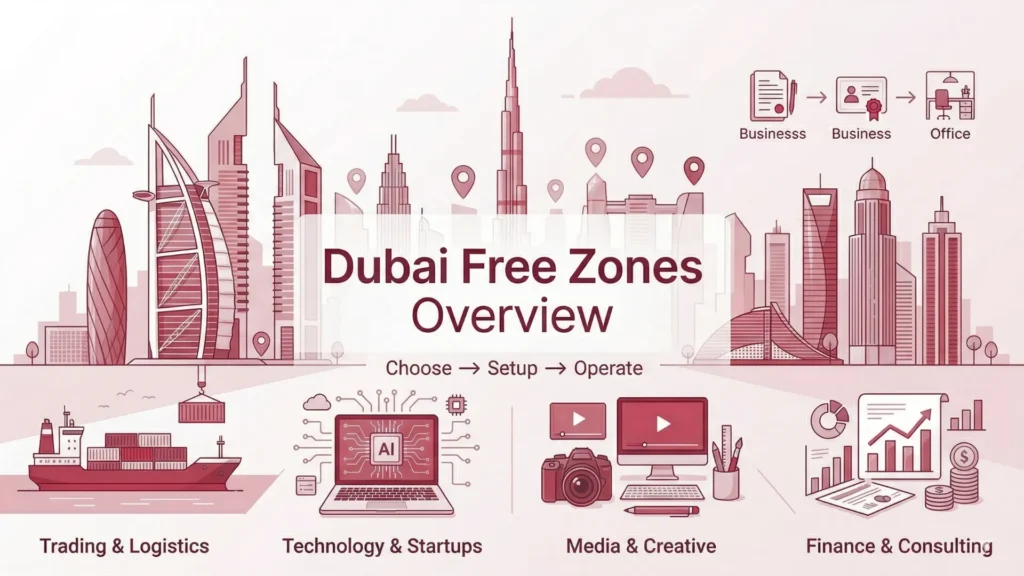
Dubai’s free zones were developed around different economic sectors. Several now permit a wider range of activities, but their infrastructure and business communities still reflect their original areas of specialisation.
Free Zones for Trading and Logistics
JAFZA is one of the most established options for import, export, manufacturing, storage and international distribution. It is particularly relevant to businesses that require port access, warehouses or industrial facilities.
Dubai South is closely connected to aviation, air cargo, fulfilment and logistics operations, while DAFZ is suitable for businesses that depend on proximity to Dubai International Airport.
DMCC supports a broad range of commodities and general trading activities, while Dubai CommerCity is more specifically focused on eCommerce and digital trade.
Free Zones for Technology and Startups
Dubai Internet City is home to technology, telecommunications, digital and software businesses. Dubai Silicon Oasis provides a wider technology and innovation ecosystem that includes startup facilities and commercial spaces.
Dubai CommerCity can be relevant to digital platforms and eCommerce technology businesses, while Dubai Science Park is more appropriate for biotechnology, medical technology and scientific companies.
Free Zones for Media and Creative Businesses
Dubai Media City serves advertising, communications, publishing and media companies. Dubai Studio City is more closely aligned with television, film and audiovisual production.
Dubai Production City supports printing, packaging and media production, while Dubai Design District focuses on fashion, architecture, art and design.
Dubai Outsource City may suit agencies and service businesses that operate shared-service, customer-support or outsourced delivery models.
Free Zones for Finance and Professional Services
DIFC is Dubai’s specialist financial jurisdiction and is commonly used by regulated financial institutions, investment companies, insurers, fintech businesses and professional firms serving the financial sector.
DMCC, DWTC and Meydan Free Zone also provide licences for various consulting and professional activities, although they do not operate under the same financial regulatory framework as DIFC.
Free Zones for Healthcare and Education
Dubai Healthcare City is the main specialist zone for medical and healthcare businesses. Dubai Science Park supports pharmaceutical, laboratory, biotechnology and life-sciences companies.
Dubai International Academic City is focused on higher education, while Dubai Knowledge Park supports training, recruitment, human resources and professional learning services.
Dubai Free Zone Authorities Explained
A free zone and a free-zone authority are not always the same thing. One authority may regulate several separate business districts.
The Dubai Free Zones Council currently identifies the following 11 authorities:
| Free-Zone Authority | Main Zones or Districts |
|---|---|
| Jebel Ali Free Zone | JAFZA |
| Dubai Development Authority | DIC, DMC, DSC, DPC, DOC, DKP, DIAC, DSP and d3 |
| Dubai International Financial Centre | DIFC |
| Dubai Multi Commodities Centre | DMCC |
| Dubai Integrated Economic Zones Authority | DAFZ, DSO and Dubai CommerCity |
| Dubai South | Dubai South |
| Expo City Dubai | Expo City Dubai |
| Dubai World Trade Centre | DWTC Free Zone |
| Meydan Corporation | Meydan Free Zone |
| Dubai Healthcare City Authority | Dubai Healthcare City |
| Dubai Humanitarian | Dubai Humanitarian |
The relevant authority controls matters such as company registration, permitted activities, licence renewal, office requirements, amendments, share transfers and company deregistration.
Authority-specific rules also affect accounting records, audit-report submission and the appointment of approved auditors. For example, DMCC and JAFZA have formal annual audit-submission requirements. JAFZA states that FZE and FZCO entities must provide an updated audit report annually.
Businesses registered in the technology and media districts can review Capital Plus Auditing’s DDA-approved auditor services for assistance with financial-statement preparation and authority submissions.
Cost of Setting Up a Free Zone Company in Dubai
There is no single price for a Dubai free-zone licence. The final setup cost depends on the jurisdiction, activity, legal structure, number of shareholders, workspace, visa allocation and external approvals.
Dubai’s official business portal confirms that free-zone setup costs vary according to requirements such as rented office space and the number of visas issued through the company.
Licence and Registration Costs
The initial quotation may include the commercial licence, company registration, trade-name reservation and incorporation documents. Some packages combine these charges, while other authorities show them separately.
Regulated activities may require approval from another authority, which can add application fees and extend the setup process.
Workspace Costs
Workspace options may include a shared workstation, flexi desk, serviced office, dedicated office, retail unit, warehouse, industrial unit or commercial land.
A low-cost licence package may include only limited workspace access and may not support the number of visas, employees or operational facilities the company eventually requires.
Visa and Immigration Costs
A visa package can involve an establishment card, entry permit, status change, medical fitness examination, Emirates ID, residence visa and health insurance.
The total cost increases with the number of shareholders, managers and employees requiring UAE residence visas.
Ongoing and Additional Costs
Businesses should also budget for annual licence renewal, office renewal, bookkeeping, corporate tax compliance, VAT returns, audit fees, immigration renewals and any industry-specific permits.
Bank account assistance, document attestation, translations and corporate shareholder documentation may also create additional costs.
If the company is later closed, it must follow the authority’s formal deregistration procedure. Our guide to free-zone company liquidation in Dubai explains why allowing a licence simply to expire is not the same as legally closing the company.
Can a Dubai Free-Zone Company Operate on the Mainland?
A free-zone company should not assume that its free-zone licence automatically authorises every activity throughout mainland Dubai.
However, the rules have changed from the older position commonly repeated in many online articles. Under Dubai Executive Council Resolution No. 11 of 2025, a company licensed by a Dubai free-zone authority may operate outside its free zone and within Dubai when it obtains the appropriate licence or permit from the Dubai Department of Economy and Tourism.
The available route may involve a mainland branch licence, a branch with its headquarters in the free zone or a permit covering specific activities. Businesses operating outside the free zone must also maintain separate financial records for those mainland operations.
The required approval depends on the activity and the implementation arrangements between DET and the relevant free-zone authority.
Corporate Tax for Dubai Free-Zone Companies
A free-zone licence does not create an automatic exemption from UAE Corporate Tax.
All free-zone persons that fall within the Corporate Tax regime must register with the Federal Tax Authority and comply with the relevant return-filing requirements. A Qualifying Free Zone Person may benefit from a 0% Corporate Tax rate on Qualifying Income, but only when the applicable conditions are met.
The conditions can involve qualifying activities, excluded activities, adequate substance, qualifying income, transfer-pricing compliance, the de minimis requirement and audited financial statements.
Income that does not receive qualifying treatment may be subject to the applicable Corporate Tax rate.
Because the 0% treatment depends on the company’s actual activities and transactions, businesses should not rely only on the wording shown on their commercial licence. Capital Plus Auditing provides a detailed Free Zone QFZP status assessment to evaluate eligibility and identify potential exposure.
Free-zone entities should also complete their UAE Corporate Tax registration within the applicable deadline.
VAT Requirements for Free-Zone Companies
Being established in a free zone does not automatically remove a company from the UAE VAT system.
A resident business must generally register for VAT when its taxable supplies and imports exceed the mandatory registration threshold of AED 375,000. Voluntary registration may be available when taxable supplies, imports or taxable expenses exceed AED 187,500.
It is also important to distinguish between a free zone and a Designated Zone for VAT purposes. Only certain zones are recognised as Designated Zones, and special treatment generally applies to limited transactions involving goods when the required conditions are met.
Services supplied from a free zone do not automatically become outside the scope of VAT.
Businesses approaching the threshold can review our VAT registration services in Dubai before making their first application or filing a return.
Do Dubai Free-Zone Companies Require an Audit?
Audit requirements depend on both the free-zone authority and the company’s Corporate Tax position.
Some authorities require companies to appoint an approved auditor and submit audited financial statements annually. DMCC and JAFZA are clear examples. Dubai Development Authority also has company regulations and circulars addressing audited financial-statement requirements.
Separately, Ministerial Decision No. 84 of 2025 requires every Qualifying Free Zone Person to prepare and maintain audited financial statements for tax periods beginning on or after 1 January 2025. The decision also applies to taxable persons with revenue exceeding AED 50 million during the relevant tax period.
A company should therefore check three separate matters:
- Whether its free-zone authority requires an annual audit.
- Whether it intends to maintain Qualifying Free Zone Person status.
- Whether another legal, banking, shareholder or contractual requirement makes an audit necessary.
Our article explaining whether an audit is mandatory for all UAE companies provides more detail on the difference between statutory, authority and commercial audit requirements.
How to Search for a Company Registered in a Dubai Free Zone
There is no single static webpage containing the names of every company registered across all Dubai free zones.
Dubai’s Invest in Dubai platform provides a licence search facility that allows users to search using a company’s English or Arabic business name, licence number or Dubai Unified Licence number.
You can also verify a business through the relevant free-zone authority where a public directory or verification service is available.
When checking a company, confirm:
- The exact legal business name
- Licence status
- Issuing authority
- Licensed activities
- Licence or Dubai Unified Licence number
- Registered legal form
A marketing name, website name or brand name may be different from the company’s legal registered name.
Common Mistakes to Avoid
One of the most common mistakes is assuming that every free-zone company automatically receives 0% Corporate Tax treatment. The company must meet the applicable Qualifying Free Zone Person conditions.
Another mistake is confusing a normal free zone with a Designated Zone for VAT. The two terms are not interchangeable.
Businesses may also underestimate the full cost by focusing only on the advertised licence fee while excluding visas, office space, establishment cards, accounting, tax filings and annual renewals.
Using an outdated authority name can also create confusion. For example, Dubai Airport Freezone, Dubai Silicon Oasis and Dubai CommerCity are now governed through the Dubai Integrated Economic Zones Authority.
Companies should not begin mainland operations without confirming whether a DET licence, branch licence or activity permit is required.
Finally, allowing a licence to expire does not properly liquidate a company. Employees, visas, bank accounts, tax registrations, authority clearances and legal records must be formally closed.
Quick Comparison of Popular Dubai Free Zones
| Free Zone | Common Business Focus | Governing Authority | Important Compliance Point |
|---|---|---|---|
| DMCC | Trading, commodities and professional services | DMCC | Annual audited financial statements |
| JAFZA | Logistics, manufacturing and international trade | JAFZA | Annual audit report for FZE and FZCO entities |
| DIFC | Finance, fintech and professional services | DIFC | Separate financial and legal regulatory framework |
| DAFZ | Aviation, trading and air-cargo businesses | DIEZ | Activity and facility requirements vary |
| DSO | Technology, innovation and startups | DIEZ | Confirm current DIEZ and DSO requirements |
| Dubai CommerCity | eCommerce and digital trade | DIEZ | Review logistics, tax and transaction structure |
| Dubai Internet City | Technology, software and telecoms | DDA | DDA company and audit rules apply |
| Dubai Media City | Media, marketing and communications | DDA | Activity-specific licensing may apply |
| Dubai South | Aviation, logistics and warehousing | Dubai South | Facility and visa requirements affect cost |
| Meydan Free Zone | Consulting and general commercial activities | Meydan Corporation | Confirm audit, workspace and visa obligations |
| Dubai Healthcare City | Healthcare and medical services | DHCA | Sector-specific professional approvals required |
| DWTC Free Zone | Consulting, events and commercial services | DWTC Authority | Check activity and office requirements |
Frequently Asked Questions
How many free zones are there in Dubai?
The Dubai Free Zones Council reports 27 free zones governed by 11 free-zone authorities. Dubai’s official city portal currently highlights 21 named free zones that are commonly presented to investors.
What is a Dubai freezone companies list?
The phrase may refer to a list of Dubai’s free zones or a directory of companies registered inside those zones. This article lists the major investor-facing free zones. A specific company can be checked through the Invest in Dubai licence search or the relevant free-zone authority.
What is the best free zone in Dubai?
There is no single best free zone for every company. Each jurisdiction has different activities, facilities, authority rules, audit obligations and commercial strengths.
A separate comparison should consider the company’s exact activity and operating model rather than relying only on the lowest advertised licence fee.
Which is the cheapest free zone in Dubai?
There is no permanently cheapest free zone. Prices and promotional packages change, and a low base licence fee may exclude visas, workspace, immigration charges, registration costs and compliance expenses.
The correct comparison should use a written quotation showing the complete first-year and renewal costs.
Can a free-zone company operate in mainland Dubai?
A Dubai free-zone company may operate outside its free zone when it obtains the appropriate licence or permit from the Dubai Department of Economy and Tourism under the applicable regulations.
The business may also need to keep separate financial records for its mainland operations.
How long does it take to set up a Dubai free-zone company?
There is no universal setup period. A straightforward application with individual shareholders and an unregulated activity may progress relatively quickly.
Applications involving corporate shareholders, regulated activities, external approvals, industrial facilities or complex documentation normally require more time.
Do Dubai free-zone companies pay Corporate Tax?
Free-zone companies fall within the UAE Corporate Tax framework. A Qualifying Free Zone Person may receive a 0% rate on Qualifying Income when all conditions are met. The benefit is not automatic and does not necessarily cover every source of income.
Do all Dubai free-zone companies need audited financial statements?
Not every company has the same authority-level requirement. However, several authorities require annual audited accounts, and all Qualifying Free Zone Persons must prepare and maintain audited financial statements for tax periods beginning on or after 1 January 2025.
What is the cost of a Dubai free-zone licence?
The cost depends on the free zone, business activity, legal structure, workspace, visas and required external approvals.
Always compare the full setup and renewal cost rather than the advertised licence price alone.
Is every free zone a Designated Zone for VAT?
No. Only specified zones receive Designated Zone status for VAT purposes. Even within a Designated Zone, special treatment applies only to certain transactions and conditions.
Can I open a corporate bank account with a free-zone licence?
A free-zone company can apply for a UAE corporate bank account, but approval remains subject to the bank’s compliance review.
The bank may assess the company’s ownership, business model, expected transactions, source of funds, customers, suppliers, office arrangements and commercial substance.
Conclusion
Dubai officially has 27 free zones operating under 11 authorities, although the official Dubai city portal currently highlights 21 named zones for investors.
Each free zone has its own commercial focus, licensing system, facilities and compliance requirements. Registering the company is only the beginning. Free-zone businesses must also manage accounting records, Corporate Tax, VAT, audits, licence renewals and any approvals required for mainland operations.
Capital Plus Auditing supports businesses with free-zone company formation, accounting, tax registration, QFZP assessments, approved audits and company liquidation.
Speak with our team before registration or renewal to confirm the complete setup cost and the ongoing tax, audit and compliance requirements attached to your Dubai free-zone company.